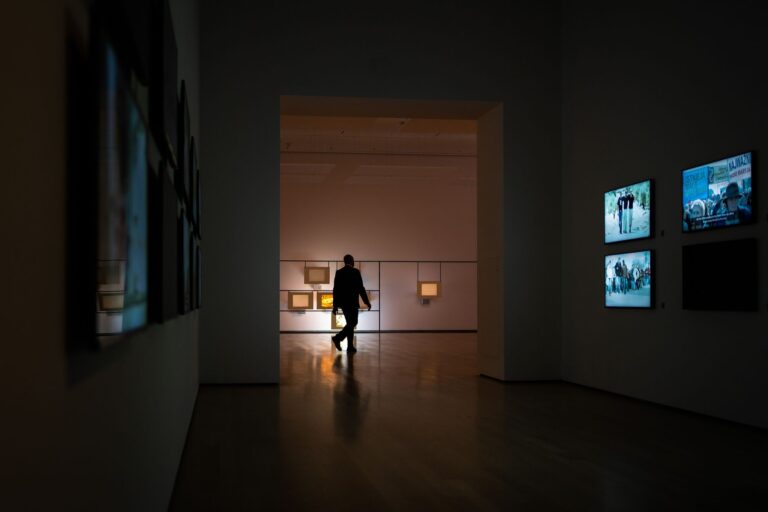
Genlock, camera tracking, and the frustum are the three interlocking technical systems that make an LED volume work as a believable production environment rather than a glorified green screen. In an LED volume — a curved or flat wall of high-density LED panels used for in-camera visual effects (ICVFX) — the background imagery must move in perfect spatial and temporal sync with the physical camera. When these systems are tuned correctly, the camera sees a photorealistic, parallax-accurate environment; when they drift even slightly, the illusion collapses. Sinfull Studios integrates these systems for virtual production work in Regina, Saskatchewan, a market where this capability remains genuinely rare.
What Is Genlock and Why Does an LED Volume Need It?
Genlock is the process of synchronizing multiple electronic devices to a shared timing reference signal — typically a bi-level black burst or tri-level sync signal — so that every device outputs frames at exactly the same moment. In an LED volume pipeline, genlock ties the camera, the LED processor, and the render nodes together. If the camera scans its sensor at a different phase than the LED panel refreshes, you get a rolling band artifact in the captured image — a visible seam that is nearly impossible to remove in post. The render nodes running Unreal Engine must also be genlocked so that nDisplay presents a completed, composited frame to the LED wall at the precise moment the camera shutter is open. Without hard sync, you are essentially gambling on whether the timings happen to align on any given frame.
How Does nDisplay Drive an LED Volume?
nDisplay is Unreal Engine’s multi-GPU, multi-node rendering framework built specifically for large-format display clusters. A single “config” asset describes the physical geometry of the LED wall — its dimensions, tile layout, and position in 3D space — and nDisplay uses that geometry to assign each render node responsibility for a specific viewport region. The nodes render in parallel and output directly to LED processors (such as those from ROE, Brompton, or Megapixel Helios), which drive the physical panels. A primary node acts as the cluster master, distributing the camera transform data and ensuring all nodes render from the same world state at the same frame. The result is a seamless image across potentially hundreds of square feet of LED surface, with no visible seams between tiles when the geometry is calibrated correctly.
What Is Camera Tracking and How Does It Feed Unreal Engine?
Camera tracking is the process of measuring the physical camera’s position, orientation, and — critically — lens data in real time, then streaming that data into Unreal Engine so the virtual camera matches exactly. Common tracking solutions include optical systems (like Mo-Sys StarTracker, which uses a ceiling-mounted star pattern), mechanical encoders on dolly and head rigs, and inertial measurement units. The tracking data is typically streamed over Live Link, Unreal’s protocol for ingesting real-time data from external sources. Lens data — focal length, focus distance, distortion coefficients — is equally important: a mismatch between the physical lens profile and the virtual camera’s projection will cause the background to appear to float or slide relative to foreground objects. This is why lens calibration with tools like the Leica T-Scan or photogrammetry-based workflows is a pre-production step, not an afterthought.
What Is the Frustum and Why Does It Move With the Lens?
The frustum is the pyramidal volume in 3D space that defines exactly what the virtual camera sees — bounded by the near and far clip planes and the four edges of the frame. In an LED volume, the frustum region of the wall is rendered with full parallax: the virtual camera’s exact perspective, accounting for position, tilt, pan, roll, and lens characteristics. The area of the LED wall outside the frustum — the “outer frustum” — is typically rendered at lower resolution or with simplified lighting, since the physical camera cannot see it directly. It still matters for reflected light on talent and set pieces, but it does not need to be photorealistic. The inner frustum tracks every micron of camera movement, which is why tracking latency and accuracy are the primary performance metrics in an LED volume — not raw LED resolution.
What Happens When Latency Is Too High?
Latency is the total delay between a physical camera movement and the corresponding update appearing on the LED wall. Even a few frames of latency causes visible “swimming” — the background lags behind the foreground motion, immediately breaking the illusion. The acceptable threshold for ICVFX work is generally under one frame at the shooting frame rate, and ideally in the single-digit milliseconds. Every link in the chain contributes: tracking system sampling rate, network transit time, render time, display scan-out, and LED panel response time. Minimizing latency requires dedicated gigabit or 10GbE networking between nodes, hardware-accelerated rendering (Lumen and Nanite in Unreal 5 are GPU-heavy, and render node specs matter enormously), and careful pipeline profiling. A simulcam feed — a real-time composite of camera video and virtual content — lets the director and DP monitor the combined image live, and it too must be low-latency to be useful on set.
How Does Lumen and Nanite Interact With LED Volume Work?
Unreal Engine 5’s Lumen global illumination and Nanite virtualized geometry are the two rendering advances that made photorealistic real-time LED volume backgrounds practical at a quality level that holds up on a cinema sensor. Nanite streams and renders film-quality asset density — Megascans environments, for instance — without the polygon budget constraints of previous real-time pipelines. Lumen computes indirect lighting dynamically, so when the virtual sun angle changes or a virtual practical light switches on, the ambient bounce light on the set updates in real time. For LED volume work, this means the physical light emitted by the wall — which fills on talent and props — is more physically consistent with the virtual environment. The tradeoff is that Lumen’s accuracy settings and hardware ray tracing configuration have a direct impact on render node frame time, which feeds directly back into latency.
What Does a Virtual Art Department Do in This Pipeline?
The virtual art department (VAD) is the team responsible for building and maintaining the Unreal Engine environments that play on the LED wall. Their work sits upstream of every technical system described above: the render nodes, frustum, and tracking systems are only as good as the environment they are rendering. VAD work includes world building with World Partition for large environments, asset optimization for real-time frame budgets, lighting design that accounts for practical on-set light matching, and close collaboration with the production designer to ensure the virtual set matches the physical set extension. At Sinfull Studios, environment art and VAD capability are core services — not subcontracted — because the quality of the virtual environment is the primary visual output the audience actually sees.
Explore Virtual Production with Unreal Engine at Sinfull Studios for more.
Frequently Asked Questions
What is genlock in an LED volume and why is it required?
Genlock is a hardware synchronization process that locks the camera, LED wall panels, and Unreal Engine render nodes to a shared timing reference — typically a tri-level sync signal. It is required because if the camera sensor scans at a different phase than the LED panel refreshes, a rolling band artifact appears in the captured image. In an LED volume used for in-camera VFX (ICVFX), all devices must output frames at the same moment to prevent visible synchronization errors that cannot be corrected in post-production.
How does camera tracking data get from the physical camera into Unreal Engine for LED volume work?
Camera tracking systems — such as optical trackers (Mo-Sys StarTracker), mechanical encoder rigs, or inertial measurement units — measure the camera’s real-time position, orientation, and lens data, then stream that data into Unreal Engine via Live Link, Unreal’s real-time data ingestion protocol. Lens calibration data, including focal length, focus distance, and distortion coefficients, is also required so the virtual camera’s projection exactly matches the physical lens. This ensures the rendered background moves with accurate parallax as the camera moves, preventing the background from appearing to float or slide relative to foreground subjects.
What is the inner frustum in an LED volume and how does it differ from the outer frustum?
The inner frustum is the region of the LED wall that falls within the physical camera’s field of view — the exact pyramidal volume defined by the camera’s position, lens characteristics, and frame boundaries. It is rendered at full quality with accurate parallax in Unreal Engine because the camera captures it directly. The outer frustum is the surrounding area of the LED wall outside the camera frame; it is typically rendered at lower fidelity since the camera does not see it, but it still contributes real emitted light to the physical set, affecting how talent and props are lit. Managing the boundary between inner and outer frustum rendering is a key performance and quality tradeoff in nDisplay configuration.
Related reading from Sinfull Studios
- What Is Virtual Production? A Plain-English Guide for Filmmakers and Brands
- In-Camera VFX Explained: How an LED Volume Captures Final Shots Live
- Virtual Scouting in Unreal Engine: Walking a Set Before You Build It
- Virtual Production on a Budget: What a Small Saskatchewan Studio Can Build
Planning a virtual production, Unreal Engine, or VFX project in Regina or anywhere in Saskatchewan? Request a quote from Sinfull Studios.